The Complete Netherlands Expat Tax Guide (2026)
The definitive guide to Dutch taxes for expats — three-box system, 2026 brackets, 30% ruling, filing process, tax credits, and comprehensive guide directory. Updated for the 2026 tax year.

Dutch Tax System Overview
The Netherlands has a progressive income tax system divided into three separate "boxes", each taxing a different type of income at different rates. As an expat, understanding this structure is essential for managing your finances and maximizing your tax efficiency.
Key features of the Dutch tax system:
- Worldwide taxation — Dutch tax residents pay income tax on their worldwide income, not just Dutch earnings. Double taxation treaties prevent you from being taxed twice (see our treaty overview).
- Three-box system — Employment income (Box 1), substantial business interests (Box 2), and wealth/savings (Box 3) are taxed separately at different rates
- Calendar year basis — The tax year runs January 1 – December 31. Box 3 assets are measured on January 1.
- Pre-filled returns — The Belastingdienst pre-fills most of your tax return using data from employers, banks, and municipalities
- Three income tax brackets (2026) — Box 1 rates of 35.75%, 37.56%, and 49.50%
- Generous expat incentives — The 30% ruling (expatregeling) is one of Europe's most attractive tax benefits for international professionals
Box 1, Box 2, Box 3 Explained
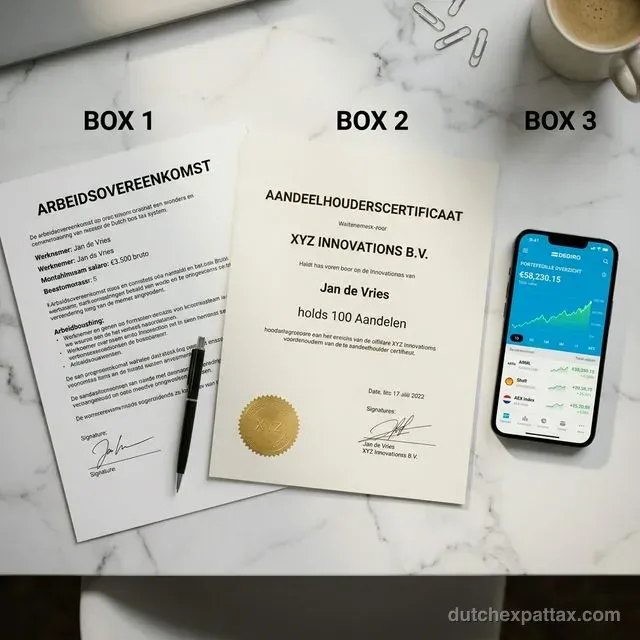
Every type of income in the Netherlands is assigned to one of three boxes. Each box has its own rates, exemptions, and rules. Here is a comprehensive overview for 2026:
Box 1 — Income from Work & Home
This is where most expats pay the majority of their tax. Box 1 includes employment income (salary, holiday allowance, bonuses), pension income, homeownership benefits (eigenwoningforfait minus mortgage interest), and certain social security benefits.
| Bracket | Taxable Income (2026) | Rate | Notes |
|---|---|---|---|
| Bracket 1 | Up to €38,883 | 35.75% | Includes income tax + social security premiums (AOW, Anw, Wlz) |
| Bracket 2 | €38,883 – €78,426 | 37.56% | Income tax only (no social security component) |
| Bracket 3 | Above €78,426 | 49.50% | Income tax only (highest marginal rate) |
For AOW-age taxpayers (67+ in 2026): the first bracket rate is 17.85% because they no longer pay AOW premiums. Brackets 2 and 3 remain the same.
Box 2 — Substantial Interest (Aanmerkelijk Belang)
Box 2 only applies if you own ≥5% of the shares (or profit/voting rights) in a company, typically a Dutch BV (Besloten Vennootschap). It taxes dividends and capital gains from that substantial interest.
| Bracket | Income (2026) | Rate |
|---|---|---|
| Bracket 1 | Up to €68,843 | 24.5% |
| Bracket 2 | Above €68,843 | 31% |
Note: the second bracket rate was 33% in 2024 and was reduced to 31% from 2025 onward. Fiscal partners can each use the €68,843 threshold independently, allowing up to €137,686 to be taxed at 24.5%. Read the full Box 2 guide.
Box 3 — Savings & Investments (Sparen en Beleggen)
Box 3 taxes your worldwide net worth (savings, investments, crypto, second properties, minus qualifying debts) above a tax-free threshold. Crucially, the Netherlands taxes a fictitious (assumed) return, not your actual gains.
| Parameter | 2026 Value |
|---|---|
| Tax-free allowance (per person) | €59,357 (fiscal partners: €118,714) |
| Tax rate on fictitious return | 36% |
| Fictitious return: bank savings | Provisional 1.28% (finalized later) |
| Fictitious return: investments & other assets | 6.00% (shares, bonds, crypto, 2nd property) |
| Fictitious return: debts | Provisional 2.70% |
For a deeper comparison of all three boxes: Box 1 vs Box 2 vs Box 3.
The 30% Ruling — Your Top Tax Benefit
The 30% ruling (expatregeling, formerly 30%-regeling) is the Netherlands' flagship tax incentive for highly skilled migrants. It allows your employer to pay up to 30% of your gross salary tax-free, as compensation for the extraterritorial costs of living abroad.
| Feature | 2026 Details |
|---|---|
| Tax-free allowance | 30% of gross salary (drops to 27% from Jan 1, 2027 for post-2023 starters) |
| Maximum duration | 5 years |
| Salary threshold — standard (2026) | Taxable ≥ €48,013 → gross ≥ €68,590 |
| Salary threshold — under 30 + Master's | Taxable ≥ €36,497 → gross ≥ €52,139 |
| Scientific researchers / AIOS | Exempt from salary threshold |
| Typical annual tax savings | €8,000 – €15,000+ (depending on salary) |
| WNT salary cap (2026) | €262,000 (2025: €246,000) |
| Partial non-residency (Box 2/3 exemption) | Abolished for new beneficiaries from Jan 1, 2025 |
Essential 30% ruling guides:
- How the 30% Ruling Works in 2026
- How to Apply — Step-by-Step
- Eligibility & Requirements
- Salary Threshold 2025–2026
- Which Countries Qualify? (150 km Rule)
- Tax Savings at Real Salary Levels
- 30% Ruling vs ZZP Freelancing
2026 Tax Rates & Brackets — Quick Reference
Box 1: Income Tax Brackets (Under AOW Age)
| Bracket | Taxable Income | 2025 Rate | 2026 Rate |
|---|---|---|---|
| Bracket 1 | Up to €38,883 | 35.82% | 35.75% |
| Bracket 2 | €38,883 – €78,426 | 37.48% | 37.56% |
| Bracket 3 | Above €78,426 | 49.50% | 49.50% |
Key Tax Credits (Heffingskortingen) 2026
| Credit | Maximum 2025 | Maximum 2026 | Phase-Out Starts |
|---|---|---|---|
| Algemene heffingskorting (general) | €3,362 | €3,115 | Income > €29,736 (reduces by 6.398%) |
| Arbeidskorting (employment) | €5,532 | €5,685 | Income > €45,592 (reduces by 6.51%) |
For complete 2025 vs 2026 comparison tables and historical data: Dutch Tax Brackets 2026 | Tax Rates 2020–2026 | Heffingskortingen Guide
Filing Your Taxes
Dutch tax returns are filed annually for the previous calendar year. In spring 2026, you are filing for tax year 2025. Here is the complete process:
- Register for DigiD — Your digital identity for government services. Activation takes 1–2 weeks by post. Start early. DigiD guide →
- Gather documents — Jaaropgaaf (annual income summary from employer), bank statements showing balances on January 1, investment portfolio statements, mortgage interest documents
- Log in to Mijn Belastingdienst — Most data is pre-filled by your employer, bank, and mortgage provider
- Review and complete — Check all three boxes, add any missing deductions, verify your fiscal partner status
- Submit by May 1 — Click Verzenden. You receive an email confirmation within minutes.
- Receive assessment — The Belastingdienst sends a voorlopige aanslag (provisional assessment) within weeks, showing your refund or payment due
| Milestone | Date | Notes |
|---|---|---|
| Tax year | January 1 – December 31 | Box 3 assets measured on January 1 |
| Jaaropgaaf received | February (from employer) | Shows gross salary, tax withheld, pension contributions |
| Filing opens | March 1 | Online via Mijn Belastingdienst with DigiD |
| Filing deadline | May 1 | Free extension available until September 1 |
| Tax advisor extension | April of following year | Your advisor requests this on your behalf |
| Refund (if filed early) | June – July | Filed close to deadline: August – October |
| M-form returns (complex) | 6 – 12 months | Paper filing may be required for first/last year |
Tax Credits & Deductions
The Netherlands distinguishes between tax credits (subtracted from your tax owed) and deductions (subtracted from your taxable income). Understanding the difference is key to optimizing your return.
Tax Credits (Heffingskortingen)
Tax credits directly reduce the amount of tax you owe. They are applied automatically in payroll and adjusted at filing:
- Algemene heffingskorting — General credit for every taxpayer: max €3,115 (2026). Phases out above €29,736, reaching €0 at €78,426. Full guide →
- Arbeidskorting — Employment credit for those with work income: max €5,685 (2026). Phases out above €45,592, reaching €0 at €132,921
- Inkomensafhankelijke combinatiekorting (IACK) — For working parents with children under 12: max €2,994 (2026)
- Jonggehandicaptenkorting — For young disabled persons receiving Wajong benefits
- Ouderenkorting — For those at or above AOW age
Deductions (Aftrekposten)
- Mortgage interest (hypotheekrenteaftrek) — Interest on loans for your primary Dutch residence is deductible, though the maximum deduction rate is capped at the second bracket rate (37.56% in 2026). Mortgage guide →
- Charitable donations (giften) — Gifts to ANBI or SBBI-registered charities above the threshold (1% of aggregate income, minimum €60) are deductible. Periodic gifts of 5+ years can be fully deducted.
- Alimony payments (partneralimentatie) — Payments to a former spouse are deductible for the payer
- Specific medical expenses — Unreimbursed medical costs exceeding a threshold (income-dependent) — limited applicability
Key Legislative Changes (2024–2027)
The Dutch tax landscape for expats has undergone significant changes. Here is a consolidated timeline of the most impactful reforms:
| Year | Change | Impact on Expats |
|---|---|---|
| 2024 | WNT salary cap introduced for 30% ruling | 30% allowance capped at the WNT norm. Transitional rule for pre-Dec 2022 holders: cap applies from Jan 1, 2026 |
| 2024 | 30→20→10% step-down introduced (then reversed) | Originally a staged reduction was planned; parliament reversed it. Flat 30% preserved for 2025–2026 |
| 2025 | Partial non-residency status abolished | New 30% ruling holders pay Dutch tax on worldwide Box 2/3 income. Transitional rule for pre-2024 holders until end 2026 |
| 2025 | Box 2 second bracket rate reduced 33% → 31% | Beneficial for BV owners with substantial interest income |
| 2025 | 30% ruling officially renamed "expatregeling" | Same benefit, new name. Still commonly called "30% ruling" |
| 2026 | Box 1 moves to three brackets | New middle bracket (37.56%) between the first (35.75%) and top (49.50%) brackets |
| 2026 | WNT salary cap: €262,000 | Now applies to all 30% ruling holders, including those with transitional arrangements |
| 2027 | 30% ruling reduced to 27% | Applies to everyone who started their ruling from 2024 onward. Pre-2024 starters keep 30% |
| 2028 | Box 3: actual return system (planned) | Replaces fictitious returns. Repeatedly delayed — originally planned for 2027 |
Common Expat Tax Scenarios
Scenario 1: First Year in the Netherlands
Your first year is the most complex tax-wise but often the most financially rewarding — many first-year expats receive a significant refund because their employer withheld tax based on full-year rates for only partial-year income.
Priority actions:
- Register at the gemeente and get your BSN (within 5 days of arrival)
- Apply for DigiD immediately (1–2 week activation)
- Apply for the 30% ruling within 4 months of your start date
- Complete the 90-day checklist
- File the M-form for your partial-year return → use our Tax Refund Estimator to see if you're owed money
Scenario 2: Dual Income — Both Partners Working
If both you and your partner work in the Netherlands, fiscal partnership (fiscaal partnerschap) can significantly optimize your taxes. Key benefits:
- Freely divide Box 3 assets between partners (allocate more to the lower earner to take advantage of the phase-out structure)
- Transfer the algemene heffingskorting if one partner has little or no income
- Optimize mortgage interest deductions between partners
Read the full Fiscal Partners guide.
Scenario 3: US or UK Expat — Double Taxation
The Netherlands has over 90 double taxation treaties. For the two largest English-speaking expat communities:
- Americans: US-NL Treaty (Foreign Tax Credit, FATCA, pension articles) + FBAR filing requirements for Dutch accounts
- British: UK-NL Treaty (post-Brexit rules, state pension aggregation, pension transfer restrictions)
Scenario 4: Tech Worker with RSUs/Stock Options
Equity compensation is increasingly common in the Netherlands, especially at ASML, Booking, Uber, Adyen, and other tech companies. Key tax considerations:
- RSU vesting is taxed as employment income in Box 1 at the market value on the vesting date
- The 30% ruling applies to RSU income — reducing the taxable portion by 30%
- After vesting, held shares are taxed as investments in Box 3
- If you leave the Netherlands while holding unvested RSUs, complex cross-border allocation rules apply
Read our dedicated Stock Options & RSU Tax guide.
Scenario 5: Leaving the Netherlands
Emigrating has immediate tax consequences: your 30% ruling terminates, Box 3 requires a final measurement, and if you own a BV, exit tax may apply. Plan at least 6 months ahead with our Leaving the Netherlands guide.
Calculators & Tools
All calculators are free, require no registration, and run entirely in your browser. Your financial data never leaves your device. Every calculator uses official 2026 Belastingdienst parameters:
| Calculator | What It Does | Link |
|---|---|---|
| 30% Ruling Calculator | Compare your net income with and without the ruling using your salary assumptions | Open → |
| Income Tax Calculator | Full Dutch income tax calculation with all three brackets, credits, and social security | Open → |
| Box 3 Tax Calculator | Calculate wealth tax on savings, investments, crypto, and property above the tax-free threshold | Open → |
| Tax Refund Estimator | Estimate your annual tax refund or amount due — especially useful for first-year expats | Open → |
Read about our calculation methodology and accuracy audit.
Complete Guide Directory
Our full library of 35+ expert-written guides, organized by topic. Every guide is updated for the 2026 tax year:
Getting Started
30% Ruling
- How the 30% Ruling Works in 2026
- How to Apply — Step-by-Step
- Eligibility & Requirements
- Salary Threshold 2025–2026
- Which Countries Qualify? (150 km Rule)
- Tax Savings: Real Salary Examples
- 30% Ruling vs ZZP
Income Tax & Brackets
- Dutch Tax Brackets 2026
- Tax Rates 2020–2026: Complete Overview
- Heffingskortingen: Tax Credits Guide
- Social Security Premiums Explained
- Box 1 vs Box 2 vs Box 3
- Box 2: Substantial Interest Guide
Tax Filing
Salary & Equity
Family & Benefits
Property & Wealth
International Tax
- Double Taxation Treaties Overview
- NL vs Germany, Belgium & UK Tax
- US-Netherlands Tax Treaty
- UK-NL Tax Treaty
- FBAR Filing for Americans
- Remote Work Tax
- Leaving the Netherlands
Pension & Insurance
Reference & Methodology
- The Ultimate Dutch Tax Glossary
- 2026 Tax Changes for Expats
- How We Calculate Taxes
- Calculator Accuracy Report
Frequently Asked Questions
Do I have to pay taxes in the Netherlands as an expat?
Yes. If you are registered as a resident in the Basisregistratie Personen (BRP) and/or earn income from Dutch sources, you are liable for Dutch income tax. The Netherlands taxes residents on their worldwide income. Non-residents are only taxed on Dutch-source income (filed via the C-form).
What is the most important tax benefit for expats?
The 30% ruling (expatregeling). It allows employers to pay up to 30% of your salary tax-free, subject to eligibility, cap, and payroll setup. At a €75,000 salary, the annual benefit can be material, but it depends on your facts. Use our 30% Ruling Calculator to model your scenario.
When do I need to file my Dutch tax return?
The filing period opens March 1 each year (for the previous year). The deadline is May 1. You can request a free extension until September 1. Tax advisors can often extend until April of the following year. See our Tax Deadlines Calendar for all key dates.
Can I file in English?
The Belastingdienst portal (Mijn Belastingdienst) is primarily in Dutch. However, the English section of belastingdienst.nl provides guides. The Internationals Tax Service (ITS) in Amsterdam, Rotterdam, and Eindhoven offers in-person English-language support.
Is it worth hiring a tax advisor?
For simple situations (single income, standard P-form, 30% ruling in place), you can file yourself using our guides and calculators. For complex situations — first-year M-form, BV ownership, international investments, leaving NL — a specialist typically costs €200–€500 and often identifies deductions and optimizations worth far more.
How much does a Dutch tax advisor cost for expats?
Basic expat filing: €150–€400. Complex M-form or multi-country returns: €500–€1,000+. Tax advisor fees are no longer tax-deductible for individuals (this deduction was abolished along with mixed costs in 2022).