Box 3 Tax Explained for Expats
Understanding the Dutch Box 3 wealth tax — fictitious returns, asset categories, tax-free thresholds, and strategies to minimize your liability.

What Is Box 3?
The Dutch tax system divides income into three "boxes." Box 3 covers income from savings and investments — also known as the wealth tax (vermogensrendementsheffing).
Unlike many countries that tax realized capital gains, the Netherlands taxes a fictitious return on your assets. This means you pay tax on what the government assumes you earned, regardless of your actual investment returns.
- Box 1: Income from employment and home ownership (see Dutch Tax Brackets)
- Box 2: Income from a substantial interest (≥5% shareholding in a company)
- Box 3: Income from savings and investments (this guide)
Three Asset Categories
Since 2023, the Belastingdienst splits Box 3 assets into three categories, each with its own fictitious return rate:
| Category | What It Includes | 2026 Return Rate |
|---|---|---|
| Bank Savings | Cash in savings accounts, current accounts, term deposits | 1.28% |
| Investments | Stocks, bonds, mutual funds, crypto, real estate (not your primary home) | 6.00% |
| Debts | Personal loans, margin debt (not mortgage on primary home) | 2.70% (deductible) |
Box 3 Asset Category Breakdown (2026)
Here's how the Box 3 system works across different asset levels, showing the tax-free threshold, fictional returns, and effective tax rates:
| Asset Type | Fictional Return Rate 2026 | Tax-Free Threshold (Single) | Effective Tax Rate on €100k |
|---|---|---|---|
| Bank Savings | 1.28% (provisional) | €59,357 | ~0.19% |
| Investments (Stocks, ETFs) | 6.00% | €59,357 | ~0.87% |
| Cryptocurrency | 6.00% | €59,357 | ~0.87% |
| Second Home / Investment Property | 6.00% | €59,357 | ~0.87% |
| Debts (Personal Loans) | 2.70% (deductible) | N/A | Reduces taxable base |
Note: Effective tax rate is calculated as (fictional return × 36% tax rate) on the amount above the tax-free threshold. For €100k in investments: (€100k - €59,357) × 6.00% × 36% = €876, which is 0.87% of €100k. Fiscal partners can combine their thresholds for €118,714 total exemption.
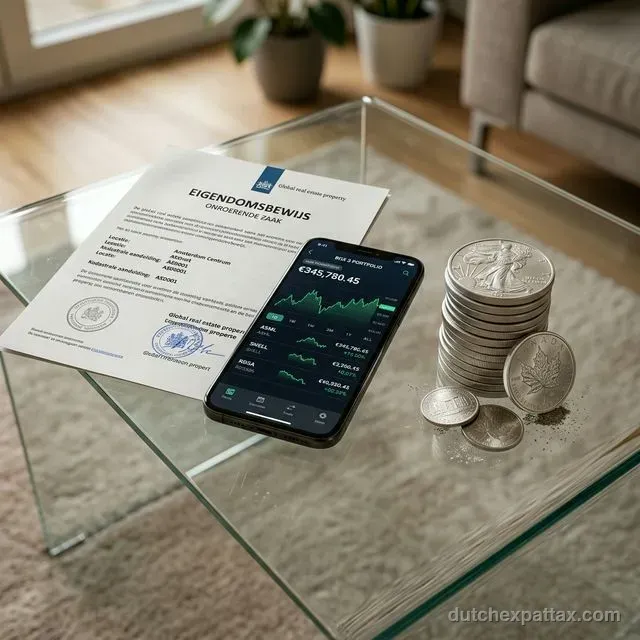
Fictitious Return Rates 2026
The fictitious return system calculates a weighted return based on your asset mix. The Belastingdienst then applies a flat 36% tax rate on this deemed return.
The formula is:
- Calculate the fictitious return per asset category (value × return rate)
- Sum the bank and investment returns, then subtract the debt return
- Divide the net return by total net assets to get a weighted return rate
- Apply that weighted rate to your taxable base (net assets minus exemption)
- Tax = taxable return × 36%
This sounds complex, but our Box 3 Calculator does all the math for you.
Tax-Free Threshold
Not all of your Box 3 wealth is taxable. The Belastingdienst provides a generous tax-free threshold:
| Situation | 2025 | 2026 |
|---|---|---|
| Single person | €57,684 | €59,357 |
| With fiscal partner (combined) | €115,368 | €118,714 |
Only assets above these thresholds are subject to Box 3 tax. For many expats with modest savings, this means no Box 3 tax at all.
Calculation Example
Let's calculate the 2026 Box 3 tax for an expat with the following assets on January 1, 2026:
- Bank savings: €80,000
- Investment portfolio: €50,000
- Personal debt: €10,000
Step 1: Calculate fictitious returns
- Bank: €80,000 × 1.28% = €1,024
- Investments: €50,000 × 6.00% = €3,000
- Debts: Only the portion above the €3,800 threshold is deductible: €10,000 − €3,800 = €6,200
- Debt return: €6,200 × 2.70% = −€167
- Net fictitious return: €1,024 + €3,000 − €167 = €3,857
Step 2: Calculate net assets and taxable base
- Gross assets: €80,000 + €50,000 = €130,000
- Deductible debts: −€6,200 (only the portion above the €3,800 threshold)
- Net assets: €123,800
- Exemption: −€59,357
- Taxable base: €64,443
Step 3: Calculate weighted return rate and tax
- Weighted return rate: €3,857 ÷ €123,800 = 3.116%
- Taxable return: €64,443 × 3.116% = €2,008
- Box 3 tax (36%): €2,008 × 0.36 = €723
Verify this calculation with our Box 3 Calculator.
Box 3 Historical Rates (2021–2026)
The Box 3 system has changed significantly in recent years. Here is a comparison of key parameters. For a complete multi-year rate overview, see our Dutch Tax Rates History.
| Year | Exemption | Tax Rate | Savings Return | Investment Return | Effective Tax on €200k* |
|---|---|---|---|---|---|
| 2021 | €50,000 | 31% | Fixed tiers (old system) | ~€1,220 | |
| 2022 | €50,650 | 31% | Fixed tiers (old system) | ~€1,250 | |
| 2023 | €57,000 | 32% | 0.36% | 6.17% | ~€2,825 |
| 2024 | €57,000 | 36% | 1.03% | 6.04% | ~€3,109 |
| 2025 | €57,684 | 36% | 1.37% | 5.88% | ~€3,052 |
| 2026 | €59,357 | 36% | 1.28% | 6.00% | ~€2,893 |
* Approximate Box 3 tax for a single person with €200,000 in a mix of 60% savings and 40% investments, no debts.
Minimizing Box 3 Tax
While you cannot avoid Box 3 tax entirely (unless your assets fall below the threshold), there are legal strategies to reduce your liability:
- Maximize the exemption — If you have a fiscal partner, you can split assets to use both exemptions (€118,714 combined in 2026).
- Shift assets to bank savings — Bank savings have a much lower fictitious return rate (1.28%) compared to investments (6.00%). If your actual investment returns are lower than 6%, you're being overtaxed on that category.
- Time large purchases — Since Box 3 is measured on January 1, spending cash on major purchases before year-end reduces your taxable wealth.
- Use allowable deductions — Pay off debts that are not deductible in Box 3 (like a credit card balance) and keep deductible debts (personal loans).
- Invest via a BV — For larger portfolios (generally €500k+), investing through a Dutch BV shifts income from Box 3 to Box 2, which may be more tax-efficient.
Partial Non-Resident Option (Abolished)
Until 2025, expats with the 30% ruling could opt for partial non-resident taxpayer status for Box 2 and Box 3. Under this option:
- You were treated as a non-resident for Box 3 purposes
- Only Dutch real estate and Dutch business interests were taxable in Box 3
- Foreign bank savings, foreign investments, and foreign property were exempt
This was one of the most powerful benefits of the 30% ruling. If you held this status before 2024, you can continue using it through 2026 under transitional arrangements. However, you should be aware that choosing partial non-resident status means you lose certain resident tax benefits, such as the mortgage interest deduction.
Frequently Asked Questions
Do I have to report foreign bank accounts in Box 3?
Yes, as a Dutch resident taxpayer, you must report all worldwide assets in Box 3, including foreign bank accounts, foreign investments, and foreign real estate.
Is cryptocurrency taxed in Box 3?
Yes, cryptocurrency is classified as an investment and taxed at the 6.00% fictitious return rate. Its value on January 1 of the tax year is what counts.
Is my primary home taxed in Box 3?
No. Your primary residence (eigen woning) is taxed in Box 1, not Box 3. However, second homes and investment properties are included in Box 3.
When do I file Box 3 tax?
Box 3 is part of your annual income tax return (aangifte inkomstenbelasting). The filing deadline is May 1 of the year following the tax year. See our Filing Dutch Taxes as an Expat guide for the step-by-step process.
Will the Box 3 system change?
Yes. The Dutch government plans to replace the fictitious return system with a tax on actual returns (werkelijk rendement), but the implementation timeline has moved. Until new legislation applies, the current system remains relevant. We will update this guide when confirmed rules change the calculation.