Buying a House: Mortgage Tax Guide
Dutch mortgage tax benefits for expats — hypotheekrenteaftrek, eigenwoningforfait, transfer tax, NHG, and how the 30% ruling affects homeownership.
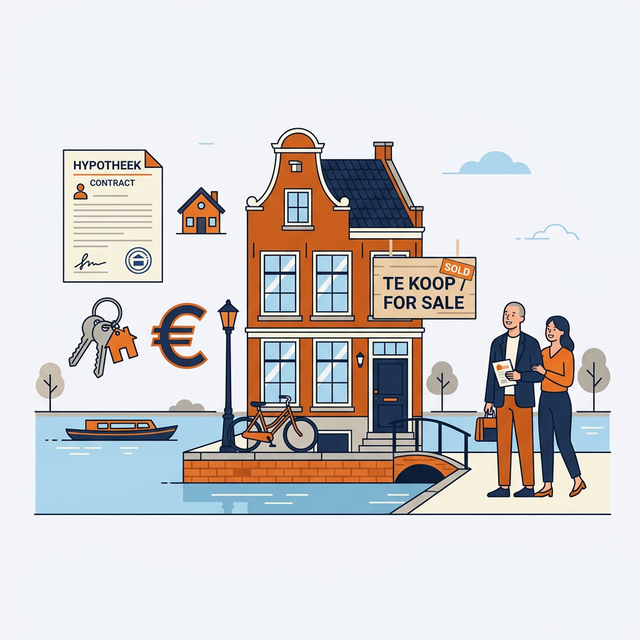
Homeownership Tax Benefits
The Netherlands offers significant tax advantages for homeowners through the eigen woning (owner-occupied home) regime. Your primary residence is treated differently from other assets — it falls under Box 1 (employment and home), not Box 3 (savings and investments).
Key benefits:
- Mortgage interest deduction (hypotheekrenteaftrek) — Deduct mortgage interest from your Box 1 taxable income
- No capital gains tax — Profit from selling your primary home is exempt
- No Box 3 wealth tax — Your primary home is excluded from Box 3
Key costs:
- Eigenwoningforfait — A deemed rental value added to your income
- Transfer tax — One-time purchase tax of 2% (primary home) or 10.4% (investment)
- Property tax (OZB) — Paid annually to your municipality
Mortgage Interest Deduction
The hypotheekrenteaftrek (mortgage interest deduction) is the Netherlands' largest personal tax deduction. How it works:
- Interest paid on a mortgage for your primary residence is deductible from your Box 1 income
- The deduction reduces your taxable income, lowering the tax you owe
- Maximum deduction rate: 36.97% (2026) — even if your marginal rate is 49.50%, the deduction is capped
- The mortgage must have a full repayment schedule (annuity or linear) to qualify — interest-only mortgages taken after January 1, 2013 do not qualify
Example:
| Scenario | Amount |
|---|---|
| Mortgage amount | €400,000 |
| Interest rate | 4.0% |
| Annual interest paid (year 1) | ~€16,000 |
| Tax deduction value (at 36.97%) | ~€5,915 |
| Minus eigenwoningforfait (0.35% × €450,000) | -€1,575 |
| Net annual tax benefit | ~€4,340 |
Eigenwoningforfait (Deemed Rental Value)
While mortgage interest is deductible, the tax authority adds a deemed rental value (eigenwoningforfait) to your income. This represents the "benefit" of living in your own home:
| WOZ Value | Eigenwoningforfait Rate (2026) |
|---|---|
| Up to €12,500 | 0.00% |
| €12,500 – €25,000 | 0.15% |
| €25,000 – €50,000 | 0.25% |
| €50,000 – €75,000 | 0.30% |
| €75,000 – €1,310,000 | 0.35% |
| Above €1,310,000 | 2.35% |
For a typical Dutch home with a WOZ value of €400,000, the eigenwoningforfait is 0.35% × €400,000 = €1,400 per year added to your Box 1 income.
Transfer Tax (Overdrachtsbelasting)
When you buy property in the Netherlands, you pay a one-time transfer tax (overdrachtsbelasting):
| Situation | Rate (2026) | Notes |
|---|---|---|
| Buyer aged 18–35 (first home) | 0% | First-time buyer exemption, up to €510,000 |
| Primary home (eigen woning) | 2% | You must live in the property |
| Investment property | 10.4% | Buy-to-let, second homes, commercial |
The first-time buyer exemption (startersvrijstelling) is a significant benefit for younger expats buying their first home in the Netherlands. If you qualify, you save up to €10,200 on a €510,000 property.
National Mortgage Guarantee (NHG)
The Nationale Hypotheek Garantie (NHG) is a government-backed mortgage guarantee that benefits buyers of properties up to €435,000 (2026):
- Lower interest rate — Typically 0.3–0.6% lower than non-NHG mortgages
- Safety net — If you cannot pay due to divorce, disability, or involuntary unemployment, the NHG may cover the remaining debt
- One-time premium — 0.6% of the mortgage amount, paid at closing and fully tax-deductible
On a €400,000 mortgage, NHG costs €2,400 upfront but can save €1,200–€2,400 annually in lower interest. Over 30 years, this can amount to tens of thousands in savings.
WOZ Value Explained
The WOZ-waarde (Wet Waardering Onroerende Zaken) is the official property valuation determined annually by your municipality. It affects:
- Eigenwoningforfait — Calculated as a percentage of WOZ value
- Municipal property tax (OZB) — Based directly on WOZ value
- Water board tax — Partially based on WOZ value
- Maximum mortgage — Banks consider WOZ value when determining loan amounts
You receive a WOZ-beschikking (valuation notice) from your municipality each year, typically in February. If you believe the valuation is too high, you can file an objection (bezwaar) within 6 weeks — this can lower your taxes.
30% Ruling & Homeownership
The 30% ruling interacts with homeownership in several important ways:
Mortgage deduction
The mortgage interest deduction reduces your Box 1 taxable income — the same income that the 30% ruling already reduces. Both benefits apply:
- 30% ruling lowers your taxable salary by 30%
- Mortgage interest deduction then further reduces taxable income
- Combined, these can significantly lower your effective tax rate
Partial non-resident status trade-off
Borrowing capacity
Most Dutch banks calculate your maximum mortgage based on gross income without the 30% ruling — because the ruling is temporary (5 years maximum). Some banks use a blended approach. This means the 30% ruling may not increase your borrowing capacity as much as you might expect.
Selling or Leaving
What happens when you sell your home or leave the Netherlands:
Selling at a profit
- Capital gains on your primary residence are exempt — No tax on the profit
- Bijleenregeling: If you buy a new home in NL, you must reinvest the equity. Otherwise, the exemption on a future mortgage interest deduction is reduced
Selling at a loss
- A loss on your primary home is not deductible
- The NHG safety net may cover a remaining debt if the loss resulted from involuntary circumstances
Keeping the property after leaving
- Your home moves from Box 1 to Box 3 once you are no longer a Dutch resident or stop living in it
- Mortgage interest is no longer deductible
- The property becomes subject to the Box 3 fictitious return system
- Rental income from the property may be taxable in the Netherlands (C-form filing required)
Frequently Asked Questions
Can I get a mortgage in the Netherlands as an expat?
Yes. Most Dutch banks offer mortgages to expats. However, some apply stricter conditions for 30% ruling holders — they may cap the mortgage based on your salary without the ruling, since the ruling is temporary. Shop around and consider an independent mortgage advisor (hypotheekadviseur).
Is the mortgage interest deduction unlimited?
No. The deduction rate is capped at 36.97% (2026). Even if your marginal tax rate is 49.50%, mortgage interest only reduces your tax liability at the capped rate. Additionally, the mortgage must have a full repayment schedule (annuity or linear) to qualify.
Does the WOZ value affect my property tax?
Yes. The WOZ value directly determines your onroerendezaakbelasting (OZB, municipal property tax), your eigenwoningforfait addition, and your water board (waterschap) tax. A lower WOZ value means lower taxes across all three.
What happens if I rent out my home?
Your home moves from Box 1 (owner-occupied, with mortgage deduction) to Box 3 (investment asset, with fictitious return taxation). You lose the mortgage interest deduction but may benefit from Box 3's treatment if your actual rental return exceeds the fictitious return rate.
Should I buy or rent as an expat?
A common guideline: if you plan to stay 3+ years, buying often makes financial sense due to the mortgage interest deduction and property value appreciation. For stays under 3 years, transaction costs (2% transfer tax + notary fees of ~€2,000–€4,000 + mortgage advisor fees) may outweigh the benefits. Use the mortgage interest deduction to model the real cost of ownership.